
Have you ever watched a badminton match and thought – “This looks so fast and exciting. I want to try this!” Maybe you have already picked up a racket and started playing in your colony or school. But every time the shuttle lands near the line, someone argues – “In or out?” And nobody really knows the answer.
That is exactly why knowing the rules of badminton matters.
Badminton is one of India’s most widely played sports. From school playgrounds in Delhi to professional academies in Gurgaon, millions of Indians play this sport every single day. But to enjoy badminton properly – and to get better at it – you need to understand how the game works. The rules, the scoring, the serving, the faults – all of it.
Do not worry. This guide explains everything in the simplest way possible. No complicated language. No confusing rulebook. Just clear, easy-to-understand badminton rules for beginners. Let us get started.
The Basic Objective of Badminton
Before jumping into rules, let us understand one simple thing – what is the goal of badminton? Players score points by hitting the shuttlecock over the net so that it lands inside the opponent’s court. A rally ends when the shuttlecock touches the ground or when a fault is committed by either side.
That is it. Simple, right?
You hit the shuttle. It must go over the net. It must land inside the opponent’s court. If your opponent cannot return it – you win the rally. Win enough rallies – you win the game.
The Badminton Court – Size and Layout
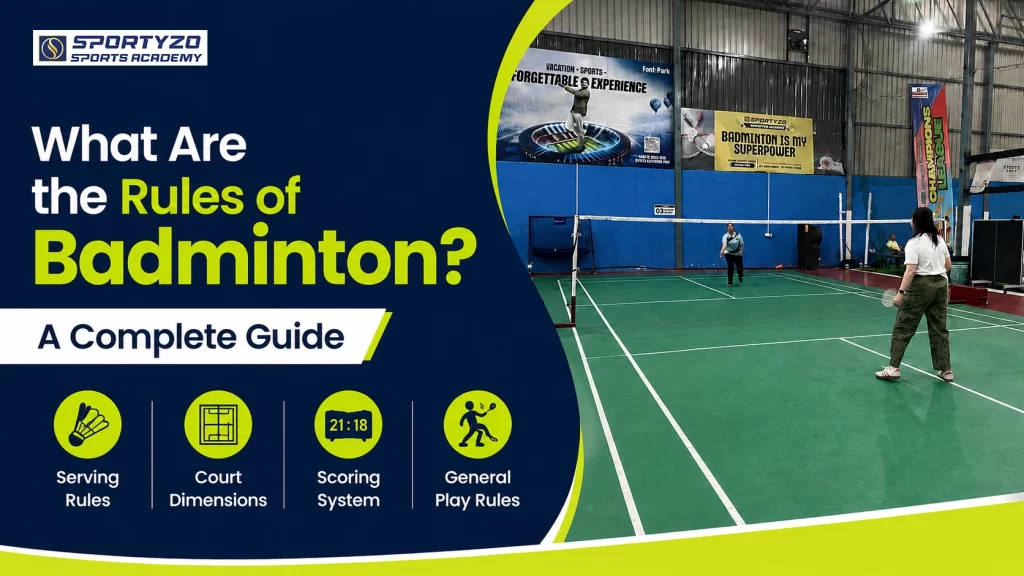
Many beginners do not know the exact size of a badminton court. And honestly, it matters because knowing the boundaries helps you understand what is “in” and what is “out.”
The game is played on a rectangular court separated by a net in the middle. Singles court dimensions are 13.4 m in length and 5.18 m in width. Doubles court dimensions are 13.4 m in length and 6.1 m in width. The net is 1.55 metres high at the posts and 1.524 metres high at the centre.
Here is the easy way to remember it:
- Singles court – narrower
- Doubles court – wider
- Net height – roughly 5 feet in the middle
The court has boundary lines, service lines, and a center line. These lines decide where you serve from and whether the shuttle is in or out during a rally. If you want to practice on a professional court, you can check out our indoor badminton court in Gurgaon which is perfectly marked and maintained for all skill levels.
The Scoring System – How Points Work

This is where most beginners get confused. Let us make it very simple.
Badminton has the rally point system, meaning there is a point given on every rally, irrespective of the server. The matches are contested in the best-of-three-games format, and each game is of 21 points. You have to win by two points or more. If the score comes to 29-all, the player who wins the next point gets the game.
So in simple words:
- Every rally = one point to the winner of that rally
- First to 21 points wins the game
- Must win by a 2-point gap
- If the score is 29-29 – next point wins
- Match = best of 3 games
The team that serves scores a point if they win a rally, and they get to keep on serving. The team that receives gets a point if they win the rally, and they get to serve next.
Serving Rules (The Most Important Part)
Serving is where most beginners make mistakes. And a wrong serve means the opponent gets the point. So pay close attention here.
The serve in badminton is an underhand stroke delivered diagonally across the net. Your starting position depends entirely on your current score: you serve from the right service court when your score is even (0, 2, 4…) and from the left court when your score is odd (1, 3, 5…).
Here are the key serving rules in simple points:
- The whole shuttle must be below 1.15 metres from the court surface when it is struck, and the racket must move continuously forward during the service.
- Both feet must stay on the ground while serving.
- The server should hit the shuttlecock from its base.
These serving rules are part of the official Laws of Badminton published by BWF. Getting your serve right from the beginning saves a lot of frustration — and this is exactly what our coaches focus on first at our badminton academy in Gurgaon.
Singles vs Doubles – Key Differences
Badminton is played in two formats – Singles (1 vs 1) and Doubles (2 vs 2). There is also Mixed Doubles (one man and one woman on each side).
In singles badminton, each player covers the entire court alone, so placement and stamina matter enormously. Doubles badminton adds a layer of strategy through positioning and partner roles.
The serving pair switches service courts only when they win a rally on their own serve. If they win a point while receiving, they win the right to serve next but remain in their current positions. This simple rule prevents positioning confusion.
- Singles – You are responsible for covering the entire court alone. You need fitness, speed, and smart placement.
- Doubles – you have a partner. Communication and positioning are everything.
Common Faults in Badminton
A fault means you broke a rule. And when you commit a fault – your opponent gets the point. Here are the most common faults that beginners make:
- Shuttle lands outside the court boundary – out of bounds
- Shuttle hits the net and does not go over – net fault
- A player hits the shuttle twice successively or the shuttle is hit successively by both partners
- You touch the net with your racket or body during a rally
- The shuttlecock is held on the racket during the execution of a shot.
- Service fault – Serving from the wrong service court or failing to meet the legal service requirements, including the 1.15-metre shuttle-height requirement
- Shuttle passes under the net instead of over it
A fault means the rally ends, and the opponent scores a point. The good news? Most of these faults are easy to avoid once you practice regularly and understand the rules properly
Switching Sides – When Does It Happen?
Many beginners do not know when players switch sides of the court. Here is the simple rule:
Players change ends after the first game, after the second game if a third game is required, and during the third game when one side first reaches 11 points. So:
- After Game 1 → both sides change ends
- After Game 2 → both sides change ends if a third game is required
- In Game 3 → change ends when one side first reaches 11 points
This ensures neither player has an unfair advantage due to lighting, wind, or court conditions.
Equipment You Need to Play Badminton

You do not need expensive equipment to start playing badminton. Here is what you need as a beginner:
- Racket – lightweight (usually 80 to 95 grams), good grip, comfortable for your hand.
- Shuttlecock – feather-based for tournaments, synthetic (nylon) for durable practice.
- Court shoes – proper non-slip badminton shoes to avoid injuries.
- Comfortable sportswear – allows completely free movement.
For beginners, a good synthetic shuttlecock and a mid-range racket is more than enough to start learning the game. If you are unsure about what to look for when buying your first racket, learning Select the Best Badminton Racket can help you choose one based on weight, grip, balance and playing style.
Tips for Beginners Before You Step on Court
Knowing the rules is only half the battle. Here are some quick tips to help you actually play better from day one:
- Learn footwork first – good movement helps you reach the shuttle faster and Improve Badminton Reflexes and Speed.
- Master your grip – forehand and backhand grips are the foundation of every shot.
- Serve low in doubles – it gives the opponent less time and angle to attack.
- Serve high and deep in singles – pushes your opponent to the back of the court.
- Keep the shuttle in play – beginners lose more points from their own errors than from the opponent’s good shots.
- Always watch the shuttle – Once you are comfortable with these basics, you can gradually move towards Advanced Badminton Moves & Techniques to develop better shot control, positioning and court movement.
Conclusion
Badminton is one of the most exciting, fast, and fun sports you can play. And now that you know the rules – the scoring, the serving, the faults, the court dimensions – you are ready to step on court with full confidence.
Whether you are a complete beginner or someone who has played casually for years, understanding the rules properly makes a huge difference. You stop arguing about line calls. You serve correctly. You know when to switch sides. You play smarter.
India has produced world class champions like PV Sindhu and Lakshya Sen who are ranked among the top players on the Badminton Association of India official rankings. Their journey started with the basics — just like yours.
And if you truly want to take your badminton game to the next level – proper coaching makes all the difference. At Sportyzo Academy in Gurgaon, expert coaches teach badminton from the basics to advanced level – for kids, adults, and everyone in between. With world-class indoor badminton courts across Sector 62, 65, 70, 71 and 72, Sportyzo is Gurgaon’s most trusted sports academy.
Ready to master the court with confidence? Visit Sportyzo Academy to book your free trial class today, pick up your racket, and fall in love with this incredible game!