
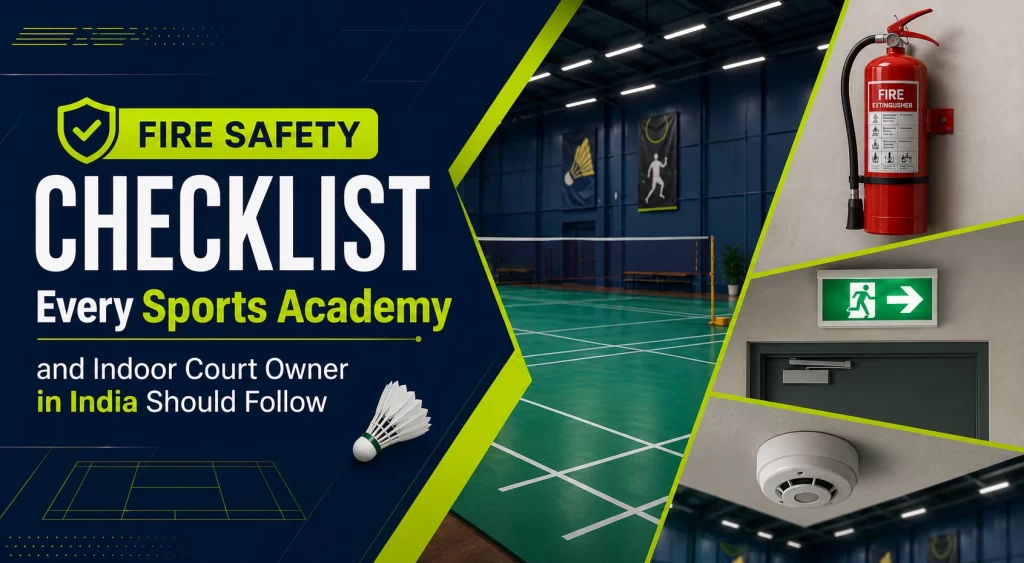
Walk into any indoor sports facility in India – a badminton hall in Gurgaon, a box cricket arena in Pune, a basketball court in Bengaluru – and you’ll spot the same setup: synthetic flooring, rows of LED floodlights, AC units running for hours, storage rooms packed with mats and turf rolls, and dozens of kids funnelled through a single entry-exit point at peak hours. Every one of those is also, quietly, a fire risk.
Fire safety rarely comes up when someone sets up a sports academy – owners think about coaches, equipment, and bookings, and treat compliance as paperwork for “later.” But indoor sports facilities are structurally closer to gyms and malls than open playgrounds, and they carry the same fire risks and legal obligations. A checklist that protects your players is the same one that protects your business and your license.
This guide breaks down exactly what sports academy owners and indoor court operators in India need to check, install, document, and drill – organised the way a fire safety audit would actually look at your facility.
Why Indoor Sports Facilities Carry Higher Fire Risk Than You’d Expect
Indoor courts aren’t just “rooms with a net in the middle.” A few features specific to sports facilities push up their fire risk profile:
- High occupancy in confined spaces – a single badminton or box cricket hall can hold 40–60 people during peak evening batches, all funnelled through one or two doors.
- Heavy electrical load – air conditioning, high-mast LED lighting, scoreboards, sound systems, and charging points for equipment all run simultaneously for 12–18 hours a day.
- Synthetic and combustible materials – PVC flooring, artificial turf, foam mats, and rubber flooring used in badminton, basketball, and box cricket setups burn fast and release toxic smoke.
- Storage of loose equipment – cricket nets, bats, mats, and maintenance chemicals are often piled in a single storeroom with no ventilation or separation from electrical panels.
- Older or converted buildings – many academies operate out of repurposed warehouses, basements, or banquet halls that weren’t originally designed with fire exits or fire-rated walls in mind.
None of this is meant to alarm facility owners – it’s simply the reality that shapes what a proper checklist needs to cover.
The Complete Fire Safety Checklist for Sports Academies and Indoor Courts
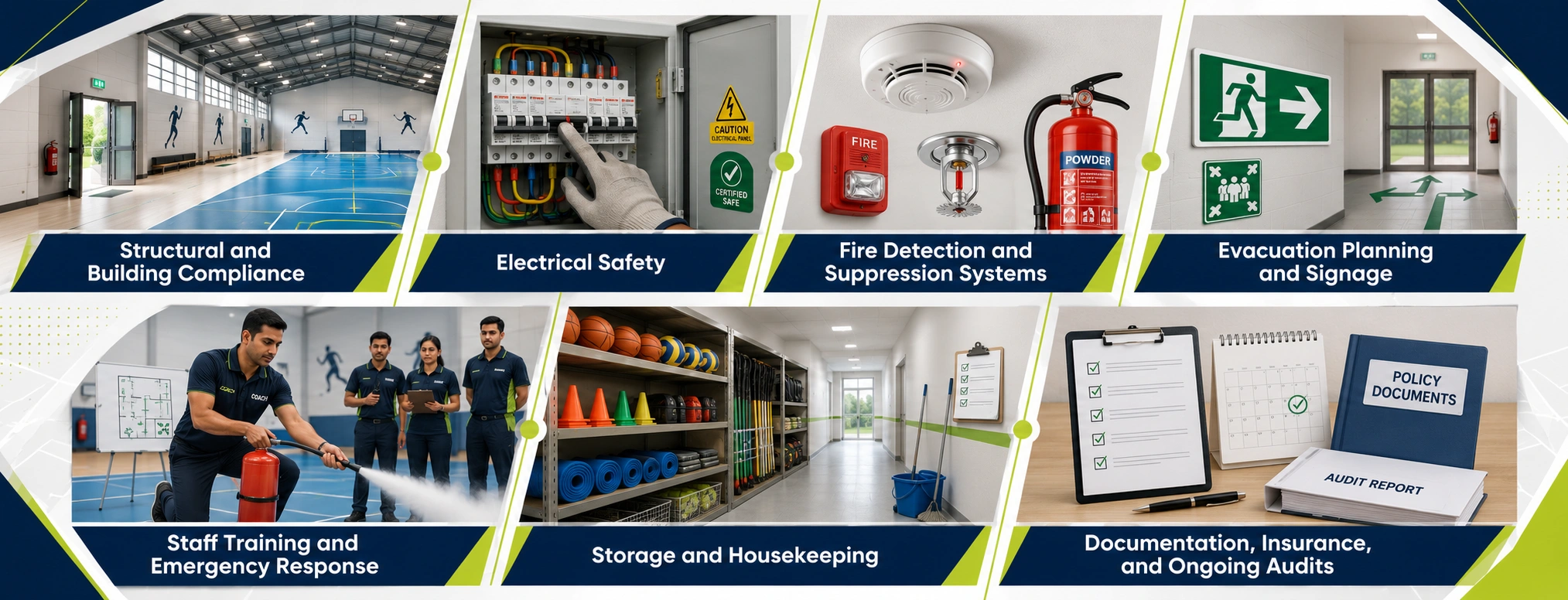
1. Structural and Building Compliance
Before anything else, the building itself needs to meet baseline fire safety standards.
- Fire NOC (No Objection Certificate) from the local Fire Department, renewed as per your state’s validity period (usually 1–3 years).
- Building compliance with the National Building Code (NBC) 2016 fire safety provisions, including fire-rated walls between the court area and storage/electrical rooms.
- Minimum two independent exit routes from every hall, clear of furniture, nets, or stacked equipment at all times.
- Exit doors that open outward and are never chained, padlocked, or blocked during operating hours.
- Adequate width of corridors and staircases as per occupancy load – this matters far more in facilities that host tournaments or corporate events with large footfall.
2. Electrical Safety
Most indoor sports facility fires in India trace back to electrical faults, not open flames. This is the section owners tend to underestimate.
- Annual electrical audit of wiring, distribution boards, and load capacity by a licensed electrician.
- Dedicated, correctly rated circuits for high-load equipment like AC units, floodlights, and generators – never daisy-chained through extension boards.
- ELCB (Earth Leakage Circuit Breaker) and MCB (Miniature Circuit Breaker) fitted and tested on every panel.
- No exposed wiring near turf, mats, or seating areas – a common issue in facilities that added lighting or sound systems after the original setup.
- Scheduled maintenance of AC units and exhaust fans, since overheating compressors are a frequent ignition source in enclosed halls.
3. Fire Detection and Suppression Systems
- Smoke detectors installed in every hall, storage room, and electrical panel area – not just the reception or office.
- Portable fire extinguisher (ABC or CO2 type, suited to electrical and combustible-material fires) placed at every exit and within 15 metres of any point in the facility.
- Extinguishers checked and refilled as per their expiry date, with a visible inspection tag.
- Fire hose reels or hydrant points where mandated by local fire codes, particularly for facilities above a certain built-up area.
- Sprinkler systems in larger complexes, especially those with multiple courts under one roof.
4. Evacuation Planning and Signage
- Illuminated “EXIT” signage that stays visible even during a power cut.
- A clearly marked assembly point outside the building where staff, students, and parents gather during an evacuation.
- Evacuation maps displayed at the entrance and inside each hall, showing the nearest exit from every court.
- Defined maximum occupancy per hall, based on exit capacity, and enforcement of it during peak batches and tournaments.
5. Staff Training and Emergency Response
A checklist on paper means nothing if the coaches and front-desk staff on the floor don’t know how to act in the first 60 seconds of an emergency.
- Fire drills conducted at least twice a year, including during active coaching sessions, not just when the facility is empty.
- Coaches and support staff trained to operate fire extinguishers and to guide players – many of whom are children – calmly toward exits.
- A designated fire warden for each shift, responsible for headcounts and coordinating with the fire brigade if needed.
- Emergency contact numbers (fire department, nearest hospital, facility manager) displayed at the reception and in every coach’s induction material.
6. Storage and Housekeeping
- Flammable maintenance materials – turf adhesives, cleaning chemicals, paints – stored in a separate, ventilated area away from electrical panels and seating.
- Loose equipment like nets, mats, and cones stored on racks rather than piled against walls or blocking corridors.
- Waste and packaging material cleared daily rather than allowed to accumulate in storage rooms.
- No smoking or open-flame zones enforced strictly across the entire facility, including outdoor waiting areas near entrances.
7. Documentation, Insurance, and Ongoing Audits
- Fire safety compliance certificate and NOC renewal dates tracked and never allowed to lapse.
- Public liability and fire insurance that explicitly covers the facility’s built-up area and equipment value.
- A maintenance log for extinguishers, alarms, and electrical checks – useful both for compliance and for reassuring parents and corporate clients who ask about safety standards.
- An annual third-party fire safety audit, especially for academies operating across multiple locations, where standards can quietly drift between branches.
Why This Belongs in Every “Facility Quality” Conversation
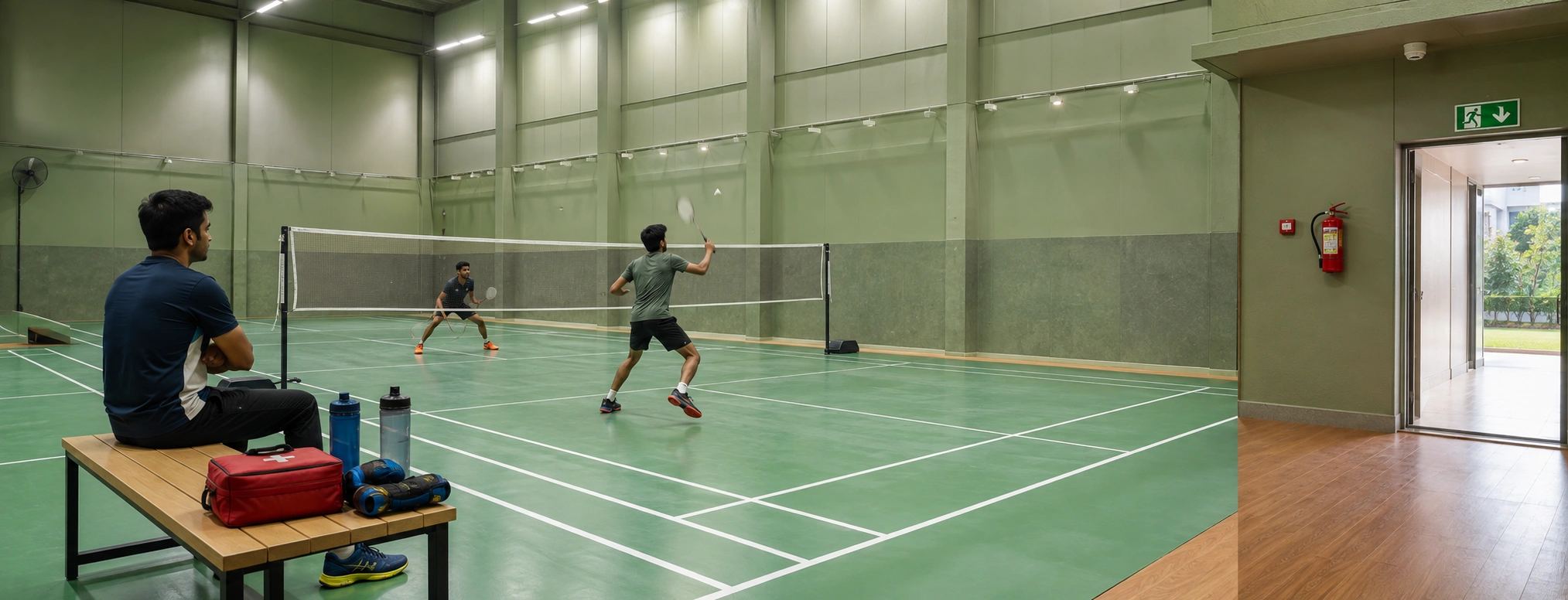
Fire safety isn’t a separate checklist from the rest of what makes an indoor sports facility good – it’s part of the same foundation as good flooring, proper lighting, and trained coaches. If you’re evaluating or building out a facility, it’s worth reading it alongside our guide on the must-have facilities in a modern sports academy, which covers the infrastructure standards parents and players notice first – safety just happens to be the standard they notice last, right up until it matters most.
It also connects closely to the broader injury-prevention conversation. Just as preventing sports injuries depends on maintained equipment and supervised training, fire safety depends on maintained systems and trained staff – both are about building an environment where players can focus on the game instead of the risks around them.
And if you’re weighing whether to run your programs indoors at all, our comparison of indoor versus outdoor sports training is a useful starting point, since indoor formats like box cricket, badminton, and basketball come with this exact set of building-safety responsibilities that outdoor grounds don’t.
Where Sportyzo Fits Into This
We bring this up because we run indoor courts ourselves – not as a fire safety vendor, but as an academy that has had to build these exact protocols into daily operations across our badminton, basketball, table tennis, and indoor box cricket facilities in Gurgaon.
Every one of our 12+ locations follows structured maintenance schedules, trained staff protocols, and the kind of well-maintained, code-compliant environment this checklist describes – because a facility that’s safe on paper only helps if it’s actually enforced on the ground, batch after batch, season after season.
If you’re a parent comparing academies, this is exactly the kind of thing worth asking about on a facility visit – not just court quality or coaching credentials, but how seriously a place takes the basics of building safety. You’re welcome to see it for yourself with a free trial class at any of our centres. And if you’re an academy or court owner benchmarking your own setup, we’re always happy to talk shop about what’s worked for us operationally.