
Buying your first badminton racket can feel confusing. You may see terms like 3U, 4U, 5U, head-heavy, head-light, G4 grip, G5 grip, stiff shaft, flexible shaft, and string tension. For a beginner, these terms can make racket selection difficult.
But choosing the right racket does not have to be complicated.
The best racket for beginners are not the one that is expensive but the one that are comfortable and doesn’t affect the wrist movement during the game. The racket, irrespective of price should be flexible and support the quick shots and don’t put unnecessary pressure on the wrist and shoulder.
This beginner badminton racket guide will help you in understanding how to choose the right badminton racket for beginners by focusing on 8 key features like grip size, racket weight, balance, flexibility, racket built material and string tension.
Why Choosing the Right Badminton Racket Matters
A wrong racket can make badminton harder than it needs to be. If the racket is too heavy, your hand may get tired quickly. If the shaft is too stiff, you may struggle to generate power. If the string tension is too high, your shots may feel weak or uncomfortable.
The right beginner racket helps you:
- Swing more easily
- Learn shots faster
- Improve control
- Reduce wrist fatigue
- Build confidence
- Enjoy longer practice sessions
- Avoid unnecessary strain
For beginners, comfort and control are more important than maximum smash power, especially for players training regularly at a badminton academy. Your first racket should help you learn the game, not make every shot feel difficult.
8 Key Factors to Check Before Buying a Badminton Racket
Here is a list of 8 key factors a beginner must consider before buying a Badminton Racket:
1. Racket Weight: Choose a Lightweight Badminton Racket
Racket weight is one of the most important factors for beginners. Badminton rackets are usually classified using “U” numbers. A higher U number means a lighter racket.
Racket Weight | Approx. Weight (gm) | Best For |
U | 95-99.9 | Strong players, strong beginners, more power |
2U | 90-94.9 | Strong Beginners, more power |
3U | 85–89g | Strong beginners, intermediate players, more power |
4U | 80–84g | Most beginners and regular players |
5U | 75–79g | Beginners, juniors, doubles players, easy handling |
6U | Below 75g | Players who want very light handling |
Beginner Recommendation: Choose 4U or 5U if you want easy handling, better control, and less fatigue.
2. Racket Balance: Head-Light, Head-Heavy, or Even Balance?
Racket balance means where the weight of the racket is concentrated. This affects power, speed, and control.
Head-Light Racket | A head-light racket has more weight toward the handle. It feels faster and easier to move. It is good for defence, quick reactions, and doubles play. |
Head-Heavy Racket | A head-heavy racket has more weight toward the racket head. It can help generate more power in smashes and clears, but it may feel slower and more tiring for beginners. |
Even-Balance Racket | An even-balance racket gives a middle path between power and control. It is useful for beginners who are still learning their playing style. |
Beginner Recommendation: Choose an even-balance or slightly head-light racket. It will help you learn both attack and defence without making the racket feel too heavy.
3. Shaft Flexibility: Flexible or Medium-Flex Is Better
The shaft is the long thin part between the handle and the racket head. Its flexibility affects how easily you can generate power.
- Flexible Shaft: due to flexibility this rackets bend more during shot and thus help beginners in generating more powerful shots even with less swing speed.
- Flexible Shaft: due to flexibility this rackets bend more during shot and thus help beginners in generating more powerful shots even with less swing speed.
- medium -flex shaft: they are good choice for beginners who are regular with there practice and need more balance between power and shot controls.
- Stiff shaft: they are quite uncomfortable especially for beginners because they need more technical and advance level of training before using them. Thus this are ideal choice for trained players.
4. Grip Size: Pick a Handle That Feels Comfortable
While picking a good badminton racket grip size can’t be ignored. It control the wrist movement and comfort of the player. Thick grip can make wrist movement more restricted same way a thin grip size can feel uncomfortable, thus reducing the concentration of the player.
Normally, badminton rackets come in two types of grip options: towel and synthetic. And for grip size they generally includes G4, G5 and in some cases G6.
Simple tips to choose the right grip for beginners:
- Choose a grip that feels more comfortable and natural to hand
- Avoid extra thin and thick grip to have better wrist movements
- Go for tower types of grip if you have sweating issues
5. String Tension: Don’t Start Too High
String tension affects power, control, and feel. Beginners often think higher tension means better performance, but that is not always true.
Lower tension gives more repulsion and forgiveness. Higher tension gives better control but needs better technique and timing.
Kumpoo Canada’s beginner guide suggests 20–22 lbs for complete beginners, 22–24 lbs for most beginners and casual players, and 24–26 lbs for players with more stable technique.
Beginner Recommendation
Start with around 20–24 lbs, depending on your comfort, racket capacity, and playing level.
6. Racket Material: Graphite Is Better for Regular Beginners
Badminton rackets are usually made from steel, aluminium, graphite, or carbon-based materials.
- Steel Rackets: they are quite heavy and comes with basic quality. Thus, for beginners they will work ok specially for regular badminton practices.
- Aluminium Rackets: aluminium badminton rackets are affordable but there quality is not good as compared to graphite or steel rackets. Also the comfort level provided by graphite rackets are missing here.
- Graphite Rackets: graphite rackets are best compared to other two because they are super light weight, comfortable , easy to grip and best for regular badminton practices. Thought the price can be on the higher side but so are the benefits.
7. Head Shape: Choose an Isometric Frame
Head shape in badminton racket are generally in 2 main types: oval and isometric.
Beginners should choose isometric head shape frame because it gives large sweet spot. This means even if the shuttle does not hit the exact centre of the badminton racket you till can hit a descent shot.
For beginners, this is helpful because timing is not always perfect in the early stages.
8. Playing Style: Singles, Doubles, or Both?
Beginners may not know their playing style at the start. That is why an all-round racket is usually the safest option.
- Beginners aiming for badminton singles: for single players a racket with even-balance will be an ideal choice because unlike doubles a single player requires clear smashes and longer rallies.
- Beginners aiming for badminton doubles: for double players a lightweight and head-light racket will be best because unlike singles the double players need to have quick reflexes and fast defence shots.
- For Beginners Who Play Both: Choose a 4U even-balance racket with a flexible or medium-flex shaft. It gives a good mix of control, comfort, and easy power.
Best Beginner Badminton Racket Setup
Feature | Best Choice for Beginners |
Weight | 4U or 5U |
Balance | Even balance or headlight |
Shaft | Flexible or medium-flex |
Grip | Comfortable, not too thick |
String Tension | Around 20–24 lbs |
Material | Graphite preferred |
Head shape | Isometric |
Playing style | All-round racket for singles and doubles |
This setup is beginner-friendly because it supports easy handling, better control, and less physical strain.
How to Select Badminton Racket Based on Your Goal
If You Want Easy Control | If You Want More Power | If You Get Tired Quickly | If You Play Doubles Mostly |
4U or 5U weight | 3U or 4U weight | 5U lightweight racket | 4U or 5U racket |
Head-light or even balance | Slightly head-heavy balance | Head-light balance | Head-light balance |
Flexible shaft | Medium-flex shaft | Comfortable grip | Fast handling frame |
Lower string tension | Moderate string tension | Lower tension | Comfortable grip |
If You Are Still Unsure
Choose:
- 4U racket
- Even balance
- Medium-flex shaft
- Isometric frame
- 22–24 lbs string tension
This is one of the safest all-round beginner setups.
How Much Should Beginners Spend on a Badminton Racket?
Your budget depends on how often you play.
- Casual Beginners: for a beginner who is not regular with badminton practice and just playing as a casual sport they must go for a basic racket.
- Regular beginners: for a beginner who is planning to play badminton as a proper sport they must go for lightweight, graphite type badminton racket.
- Serious beginners: if you are a beginner who is planning to pursue badminton as a career, then you must invest in good quality graphite racket.
Which Badminton Racket Should Beginners Avoid?
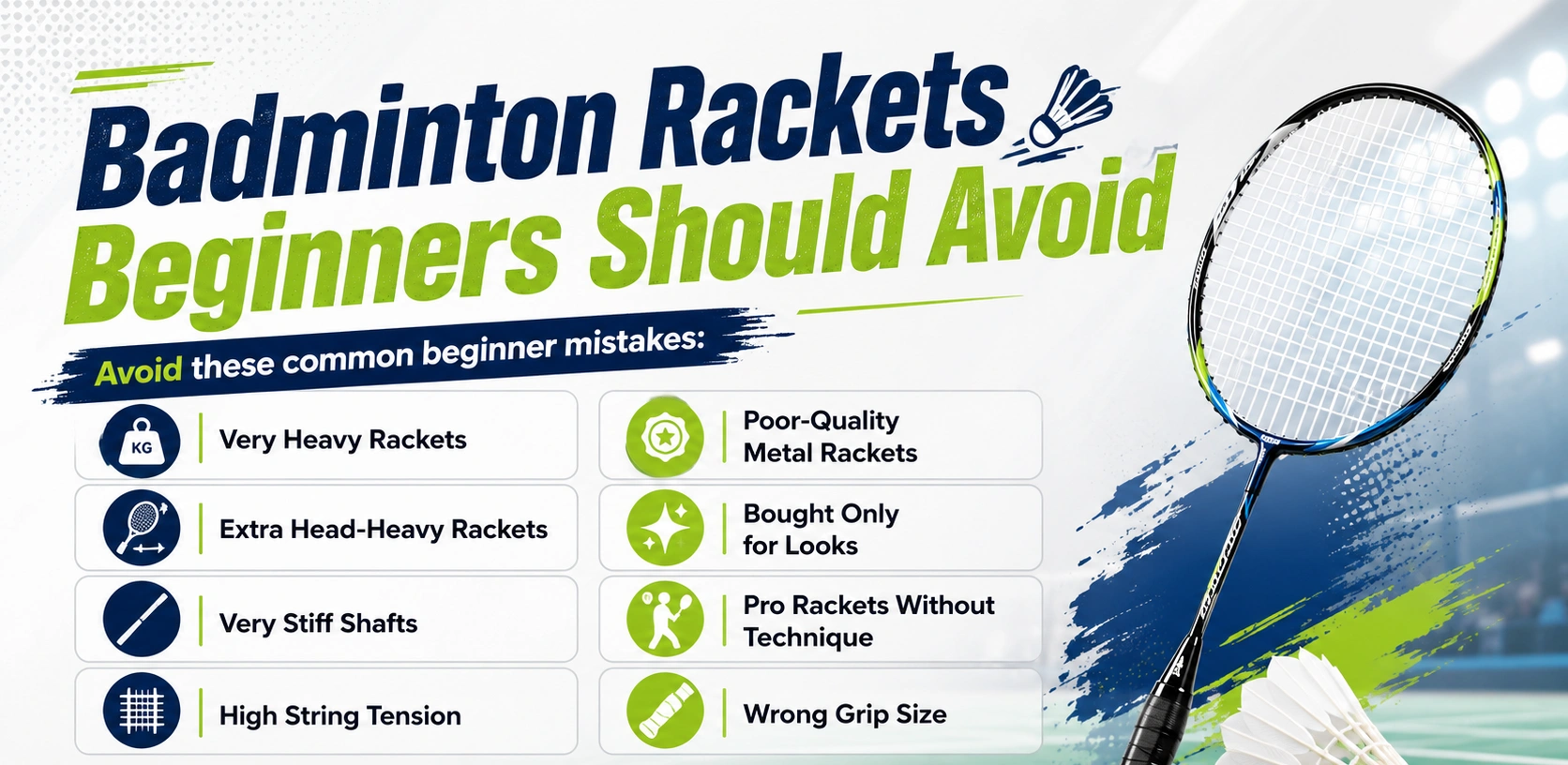
Beginners should avoid:
- Very heavy rackets
- Extremely head-heavy rackets
- Very stiff shaft rackets
- Very high string tension
- Poor-quality metal rackets for regular practice
- Rackets bought only for looks
- Advanced professional rackets without proper technique
- Rackets with uncomfortable grip size
A beginner racket should feel easy, comfortable, and forgiving.
Final Recommendation
If you are buying your first badminton racket, choose a 4U or 5U lightweight badminton racket with an even-balance or head-light frame, flexible or medium-flex shaft, comfortable grip, and 20–24 lbs string tension.
This setup provides a beginner-friendly configuration that helps players improve basic skills first and gradually move towards advanced badminton moves & techniques with better control and comfort. The program enables users to practice fundamental strokes while developing their control skills and experiencing less wrist strain and playing the game without needing to master complex racket specifications.
The best badminton racket for beginners is not the one with the highest price or biggest brand name. It is the one that makes learning easier.