
Do you remember the moment when you lost points in tennis because of your reaction and not because of your stroke? It has happened with almost every tennis player during his career. But in most cases, the reason for that is your bad footwork.
Once you learn how to improve your footwork in tennis, everything becomes different. You will be quicker, get more balls and feel better about yourself while playing tennis. We have prepared an ultimate guide for you which covers all the basics of tennis movements, as well as the best tennis movement drills that will help you to become quicker in every match. Let’s start!
Why Is Footwork Important in Tennis?
Most players spend all their time working on their strokes — forehand, backhand, serve. But footwork is the real foundation of your game. If your feet are not in the right place, even your best shot will go wrong.
Here is why footwork matters so much —
- Better positioning — Good footwork gets you behind the ball every single time.
- More power in shots — You hit harder when your body is balanced and properly set.
- Fewer unforced errors — Wrong position leads to rushed and weak shots.
- Faster court coverage — You reach wide balls that others simply cannot get to.
- Less fatigue — Efficient movement means you waste less energy during long rallies.
What Are the Basic Footwork Patterns in Tennis?
Before jumping into drills, you need to understand the basic movement patterns used in tennis. These are the real building blocks of good footwork on court.
- Split Step: The split step is a small jump you make just as your opponent hits the ball. It keeps your body alert and ready to move in any direction instantly. Every good tennis player does this automatically without even thinking about it.
- Lateral Shuffle: This is a side-to-side sliding movement used to reach balls hit wide to your left or right. You keep your body low and move sideways without crossing your feet. It is one of the most frequently used footwork patterns in tennis.
- Crossover Step: When a ball is hit very wide and a shuffle is simply not fast enough, you use the crossover step. You cross one foot over the other to cover more ground quickly. It is a faster way to chase down difficult wide shots.
- Forward and Backward Movement: Tennis is not just about moving side to side. You also need to move forward to attack short balls and backward to handle deep shots. Knowing when to move in or out is a key part of smart court movement.
- Recovery Step: After playing a shot, you need to move back to your base position as quickly as possible. The recovery step helps you reset after every shot so you are always ready and in position for the next ball.
Also Read: How to Choose the Right Tennis Racket for Your Playing Style
Once you understand these five movement patterns, your tennis footwork drills for beginners will start making much more sense when you are actually out on the court.
10 Effective Ways to Improve Footwork in Tennis
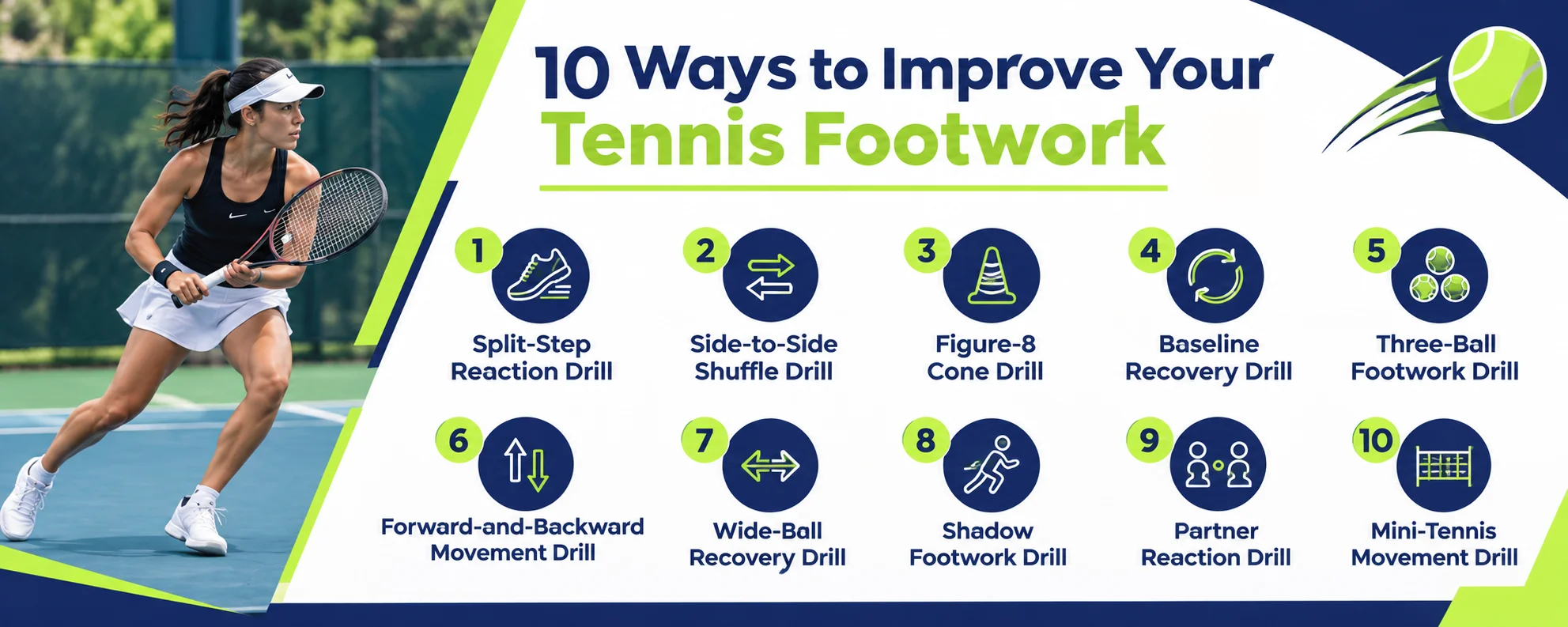
Here are the best tennis movement drills you can start practicing today to move faster and smarter on the court.
1. Split-Step Reaction Drill
Purpose: This drill trains your body to react instantly the moment your opponent hits the ball. It builds the habit of always staying on your toes and ready to move in any direction.
How to do it:
- Stand at the baseline in ready position.
- Have a partner or coach call out left or right.
- Do a small split-step jump as they call the direction.
- Push off immediately in that direction.
- Reset and repeat 10 times on each side.
Why it works: It trains your reaction time and makes the split step feel completely automatic during real match situations.
2. Side-to-Side Shuffle Drill
Purpose: This drill builds your lateral speed and helps you reach wide balls without losing your balance or body control on the court.
How to do it:
- Place two cones about 5 metres apart.
- Start at the centre in a ready position.
- Shuffle sideways to the right cone and touch it.
- Shuffle back to the left cone and touch it.
- Repeat for 30 seconds, then rest.
- Do 3 sets total.
Why it works: It strengthens your lateral movement and builds the muscle memory needed for quick side-to-side court coverage during rallies.
3. Figure-8 Cone Drill
Purpose: This drill improves your ability to change direction quickly while keeping your body balanced and fully under control at all times on court.
How to do it:
- Place 2 cones about 2 metres apart.
- Run in a figure-8 pattern around both cones.
- Focus on staying low and using small, quick steps.
- Complete 5 full figure-8 loops.
- Rest 30 seconds and repeat 3 times.
Why it works: It trains your body to change direction without slowing down, which is exactly what you need during fast tennis rallies.
4. Baseline Recovery Drill
Purpose: This drill teaches you to recover back to your base position quickly after playing a shot from wide or deep in the court.
How to do it:
- Start at the centre of the baseline.
- Sprint to the right sideline and simulate a forehand shot.
- Sprint back to the centre immediately.
- Then sprint to the left sideline and simulate a backhand.
- Sprint back to centre again.
- Repeat 8 to 10 times without stopping.
Why it works: It builds the recovery speed and stamina you need to always stay in the right position for the very next shot.
5. Three-Ball Footwork Drill
Purpose: This drill improves your ability to move quickly between different areas of the court while keeping your footwork clean and controlled throughout.
How to do it:
- Place 3 balls on the court — one on each side and one at the net.
- Start at the centre baseline.
- Sprint to pick up the right ball and bring it back.
- Sprint to pick up the left ball and bring it back.
- Sprint to pick up the net ball and bring it back.
- Time yourself and try to beat your own record each time.
Why it works: It combines speed, direction change and court awareness all together in one simple but very effective drill.
6. Forward-and-Backward Movement Drill
Purpose: This drill trains your ability to move quickly forward to attack short balls and then recover backward for deep shots without losing your balance.
How to do it:
- Start at the baseline in ready position.
- Sprint forward to the service line and simulate a volley.
- Move quickly back to the baseline using controlled steps.
- Immediately sprint forward to the net and simulate a smash.
- Recover back to the baseline.
- Repeat 8 times without stopping.
Why it works: It builds the forward and backward movement speed that most players completely ignore during their regular tennis footwork exercises training.
7. Wide-Ball Recovery Drill
Purpose: This drill trains you to sprint wide for a difficult shot and then recover back to the centre position as fast as possible every time.
How to do it:
- Stand at the centre baseline.
- Have a partner point to the far right corner.
- Sprint there and simulate an open-stance forehand.
- Recover immediately back to the centre.
- Your partner then points to the far left corner.
- Sprint there and simulate a backhand shot.
- Recover back to centre.
- Repeat 10 times total.
Why it works: It trains the exact movement pattern you need during long baseline rallies when your opponent keeps pulling you wide on every shot.
8. Shadow Footwork Drill
Purpose: This drill helps you practice all footwork patterns together without a ball so you can fully focus on your movement quality and foot speed.
How to do it:
- Stand at the centre of the baseline.
- Move to the forehand corner and simulate a shot.
- Recover to centre.
- Move to the backhand corner and simulate a shot.
- Recover to centre.
- Move to the net and simulate a volley.
- Recover to centre.
- Continue this pattern for 60 seconds.
- Rest and repeat 3 times.
Why it works: Shadow drills are used by professional players all over the world because they let you train tennis movement drills with complete focus on technique and speed.
9. Partner Reaction Drill
Purpose: This drill improves your reaction time and court movement by making you respond to unpredictable directions — exactly like what happens in a real match.
How to do it:
- Stand at the baseline with a partner facing you.
- Your partner randomly points left, right, forward or backward.
- React immediately and move in that direction.
- Touch that spot and return to centre quickly.
- Your partner points in another direction immediately.
- Continue for 45 seconds, then switch roles.
- Do 3 rounds each.
Why it works: It trains your tennis reaction drills in a game-realistic way because you never know which direction is coming next.
10. Mini-Tennis Movement Drill
Purpose: This drill uses actual mini-tennis play inside the service boxes to sharpen your footwork, balance and quick direction changes in a real hitting situation.
How to do it:
- Both players start inside the service boxes.
- Play mini-tennis rallies using only the service box area.
- Focus completely on small, quick steps and staying balanced.
- Try to keep every rally going as long as possible.
- Play 5-minute sets with short breaks in between.
Why it works: Playing in a small space forces you to use fast and precise footwork on every single shot, which directly transfers to better movement in full-court tennis.
A Simple 20-Minute Tennis Footwork Workout
You do not need hours of practice every day. Just 20 minutes of focused tennis footwork exercises can improve your movement on court. Remember to warm up properly, use the right technique, and allow enough recovery time to prevent sports injuries. Here is a simple routine you can follow right now —
| Time | Drill | Sets / Duration |
|---|---|---|
| 0–2 min | Warm Up — Light Jog Around Court | 1 round |
| 2–5 min | Split-Step Reaction Drill | 3 sets × 10 reps |
| 5–8 min | Side-to-Side Shuffle Drill | 3 sets × 30 seconds |
| 8–11 min | Figure-8 Cone Drill | 3 sets × 5 loops |
| 11–14 min | Baseline Recovery Drill | 3 sets × 8 reps |
| 14–17 min | Shadow Footwork Drill | 3 sets × 60 seconds |
| 17–19 min | Partner Reaction Drill | 3 rounds × 45 seconds |
| 19–20 min | Cool Down — Light Stretching | 1 round |
Take Your Tennis Footwork to the Next Level!
Footwork is not something you fix in one session. It takes time, the right drills, and proper coaching to see real results on court. The drills shared in this blog will definitely give you a strong head start. Having a coach correct your technique can make a big difference. Along with regular practice, learning how to maintain your tennis equipment helps keep your gear in good condition. If you are truly serious about how to improve footwork in tennis and want faster results, training under expert guidance is the smartest decision you can make.
At Sportyzo, a tennis academy in Gurgaon, our certified coaches help players of all ages improve their footwork through structured drills and personalised training. Book your free trial class today and take the first step toward moving better on court!