
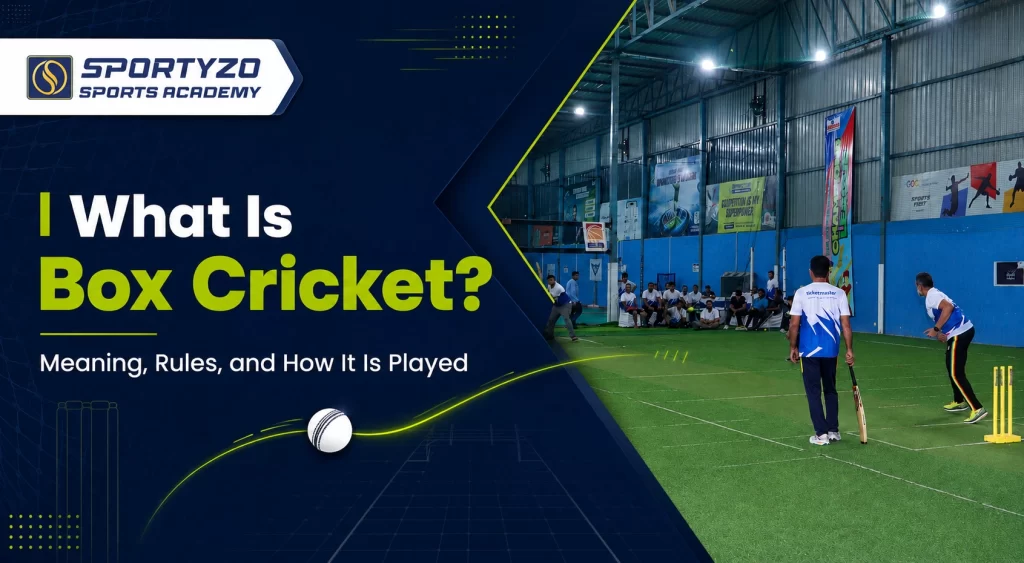
Cricket has typically been played on a large field with 11 players on each team. Naturally when living in cramped cities it can be hard finding space and time to play a full game. Box cricket provides people with the thrills of cricket in a more condensed area.
Box cricket is played on artificial grass with a net around it. The game is quick, sociable and easy to set up. There are usually less players and restricted overs, meaning games can finish quickly.
This guide explains what is box cricket, its meaning, common rules, scoring system, equipment, team size, and how the game is played. Because rules often vary between venues, players should always confirm the local format before starting.
What Is Box Cricket?
Box cricket is a shortened version of cricket played inside a compact area enclosed by nets or walls. The ground may be indoors, outdoors, on a rooftop, or inside a dedicated sports facility.
Most recreational matches use a tennis ball, taped tennis ball, or soft cricket ball instead of a leather ball. Teams commonly have six to eight players, although the number can change according to the venue or tournament.
Each team receives a limited number of overs to bat. The opposing side bowls and fields while trying to restrict the score and dismiss the batters. After the first innings, the teams exchange roles. The side with the higher total wins.
Common features include:
- A small, net-enclosed playing area
- Six to eight players per team
- Short innings of approximately four to twelve overs
- Tennis or soft cricket balls
- Artificial-turf surfaces
- Modified boundary and scoring rules
The main objective remains the same as traditional cricket: score more runs than the opposition.
Why Is It Called Box Cricket?
The name comes from the box-shaped enclosure created by side and roof nets. These nets keep the ball inside the arena, reduce interruptions, and may also form part of the scoring system.
The History of Box Cricket
The history of box cricket is commonly traced to Mumbai during the early 1980s. As the city became increasingly crowded, cricket enthusiasts had limited access to large playgrounds. Players began adapting the traditional game to smaller compounds, terraces, parking areas and other enclosed urban spaces. Nets, walls and surrounding structures were used as boundaries, giving the format its familiar “box” shape.
Unlike traditional cricket, box cricket did not develop through a single governing body or one universally accepted set of rules. It evolved organically according to the space, number of players and equipment available. Even the wider beginnings of tennis-ball cricket in India are not precisely recorded, although organised tennis-ball cricket bodies began appearing in the early 1980s.
To make cricket practical in smaller spaces, players introduced several modifications, including:
- Fewer players on each team
- Shorter matches with limited overs
- Fixed batting turns or retirement scores
- Tennis balls or taped tennis balls instead of leather balls
- Clearly defined playing areas
- Nets, walls or marked zones for scoring
- Underarm or restricted overarm bowling at some venues
- Special rules for roof hits, rebounds and net-assisted catches
By the late twentieth century, rapid urbanisation and limited access to open grounds helped the format spread beyond Mumbai to other metropolitan cities in India. Its shorter duration also made it suitable for schools, colleges, housing societies and workplace tournaments.
Over time, informal concrete or terrace games developed into organised turf cricket played on artificial surfaces with protective netting, floodlights, booking slots and digital scoring. Modern box cricket venues now host casual matches, coaching sessions, corporate events and competitive tournaments.
Today, box cricket remains popular because it preserves the basic excitement of batting, bowling and fielding while making cricket easier to organise in crowded urban areas. However, because the game developed locally, team size, scoring zones, bowling restrictions and dismissal rules may still vary from one venue or tournament to another.
Is Box Cricket the Same as Indoor Cricket?
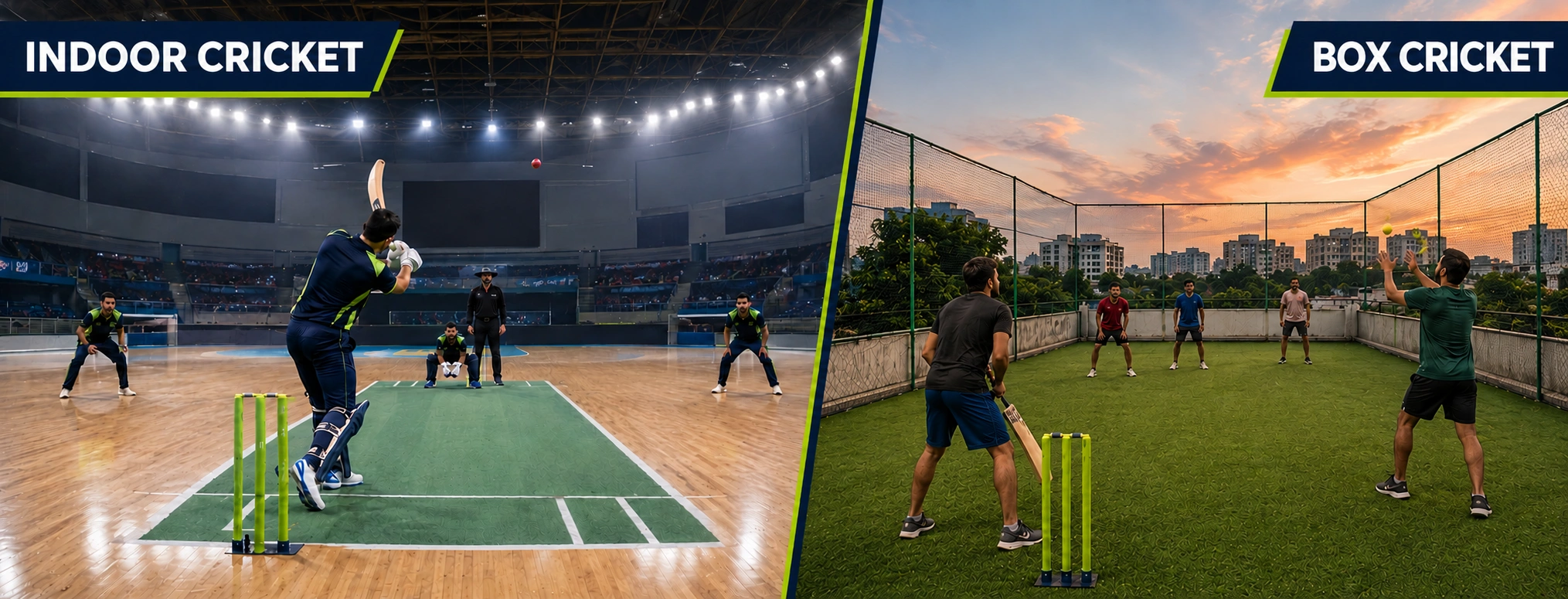
The terms are sometimes used interchangeably, but they are not always identical.
Indoor cricket may refer to an organised sport with a defined competition format. Recreational box cricket is often more flexible and may use rules created by the turf owner or tournament organiser.
Rules may differ on bowling style, roof hits, catches, and scoring, so no single rulebook applies to every facility.
How Is Box Cricket Played?
A match normally begins with a toss. The winning captain chooses whether to bat or bowl first.
Two batters start the innings while the fielding team takes its positions. The bowler delivers the ball, and the striker attempts to score by running between the wickets or hitting designated scoring zones.
The batting team continues until it completes its allotted overs or loses the permitted number of wickets. The second team then tries to chase the target.
The small ground creates a fast game. Batters need placement as much as power, while bowlers benefit from accuracy and variation. Players looking to add more pace to their bowling can also work on specific techniques and exercises to improve bowling speed.
Common Box Cricket Rules
Box cricket tournament rules vary, but the following guidelines are widely used.
1. Team Size
The usual box cricket team size is six to eight players. Some matches use five players, while larger tournaments may allow substitutes.
Organisers may require every player to bat or bowl so that one or two strong players do not dominate the game.
2. Number of Overs
Common formats include five, six, eight, ten, or twelve overs per innings. Casual bookings often use fewer overs, while tournaments may use longer innings or knockout rounds.
3. Type of Ball
Most venues use a tennis ball, taped tennis ball, or soft practice ball.
Leather balls are normally avoided unless the facility and protective equipment are suitable.
4. Bowling Rules
Bowling may be overarm or underarm depending on the arena. Each bowler is generally restricted to a fixed number of overs (usually 2 overs for each bowler in case of a 6-over match) so that several team members participate.
Wides and no-balls usually add penalty runs. Some formats require an extra delivery, while others award the run without adding another ball to keep the match moving.
5. Batting and Retirement Rules
Batters score by running or reaching recognised scoring zones.
Some venues require a batter to retire after reaching a fixed score, such as 25 or 30 runs. This gives other players an opportunity to bat. Retired batters may be allowed to return after the remaining players have batted.
6. Boundary and Net Rules
Net scoring is one of the most distinctive parts of box cricket, but it varies considerably.
A venue may award:
- One run for hitting a side net
- Two runs for reaching a marked side zone
- Four runs for hitting the back net after bouncing
- Six runs for hitting the back net directly
- No run or a dismissal for hitting the roof
These are examples rather than universal rules. Players should understand all scoring zones before the toss.
7. Dismissal Rules
Common methods of dismissal include:
- Bowled
- Caught
- Run out
- Stumped
- Hit wicket
- Leg before wicket, when included
Catch rules can also differ. Net-assisted catches and LBW decisions depend on the local rules.
8. Last Batter and Fielding Rules
Some formats allow the last remaining batter to continue with a runner at the opposite end. Other formats end the innings when only one batter remains.
Fielding restrictions may require players to stand on both sides of the pitch or remain a safe distance from the striker.
How Are Runs Scored in Box Cricket?
Box cricket scoring rules generally combine running, net zones, boundaries, and extras.
- Running Between the Wickets
Batters exchange ends after playing the ball. Each completed exchange normally counts as one run. Quick and clear calling is essential because fielders cover the smaller ground rapidly.
- Net and Boundary Runs
Marked sections of the side or back nets may have fixed run values. The score may depend on whether the ball reaches the net directly or after bouncing.
- Bonus Zones and Extras
Some grounds use coloured or marked bonus areas. Runs may also come from wides, no-balls, byes, leg byes, or penalties. Casual venues sometimes remove byes and leg byes to simplify scoring.
Box Cricket Ground and Equipment
There is no universal box cricket ground size. Dimensions depend on the available space, roof height, bowling style, and number of players.
A typical box cricket ground contains artificial turf, a central pitch, stumps at both ends, side and overhead nets, floodlights, and marked scoring zones.
The basic equipment needed for box cricket is similar to what players use in other recreational formats. Understanding Cricket Equipment Every Cricketer Needs can also help players choose the right bat, ball, protective gear, and footwear before playing.
Basic equipment includes:
- Cricket bat
- Tennis or soft ball
- Stumps
- Sports shoes
- Comfortable sports clothing
- Batting gloves or protective gear when required
- Scoreboard or scoring application
Metal spikes should not be worn on artificial turf unless the venue permits them. Players should inspect the surface and nets before starting. Because box cricket is played in a compact enclosed area, following basic safety practices and Tips to Prevent Sports Injuries can help reduce the risk of collisions, falls, and other common sports injuries.
Box cricket places greater emphasis on quick decisions, placement, and immediate pressure.
Tips for Playing Box Cricket Better
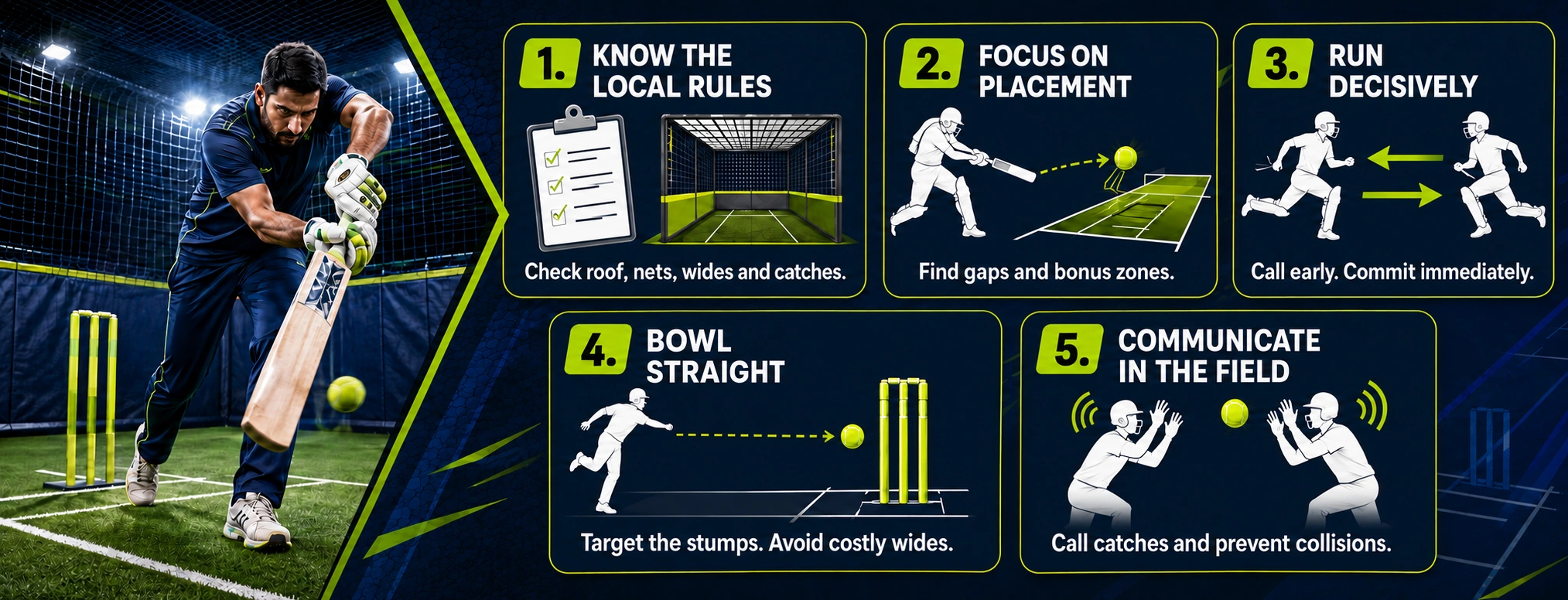
- Learn the Local Rules: Confirm how the roof, side nets, back net, wides, no-balls, and catches are scored. One misunderstood rule can decide a short match.
- Focus on Placement: The strongest shot is not always the most effective. Use gaps and bonus zones instead of trying to hit every ball for six.
- Run Decisively: Call loudly and make an immediate decision. Hesitation frequently causes run-outs on compact grounds.
- Bowl Straight: Wides can be expensive in limited overs. Accurate bowling at the stumps is often more useful than attempting too many variations.
- Communicate in the Field: Call clearly for catches and warn teammates before crossing their path. The enclosed area increases the chance of collisions.